

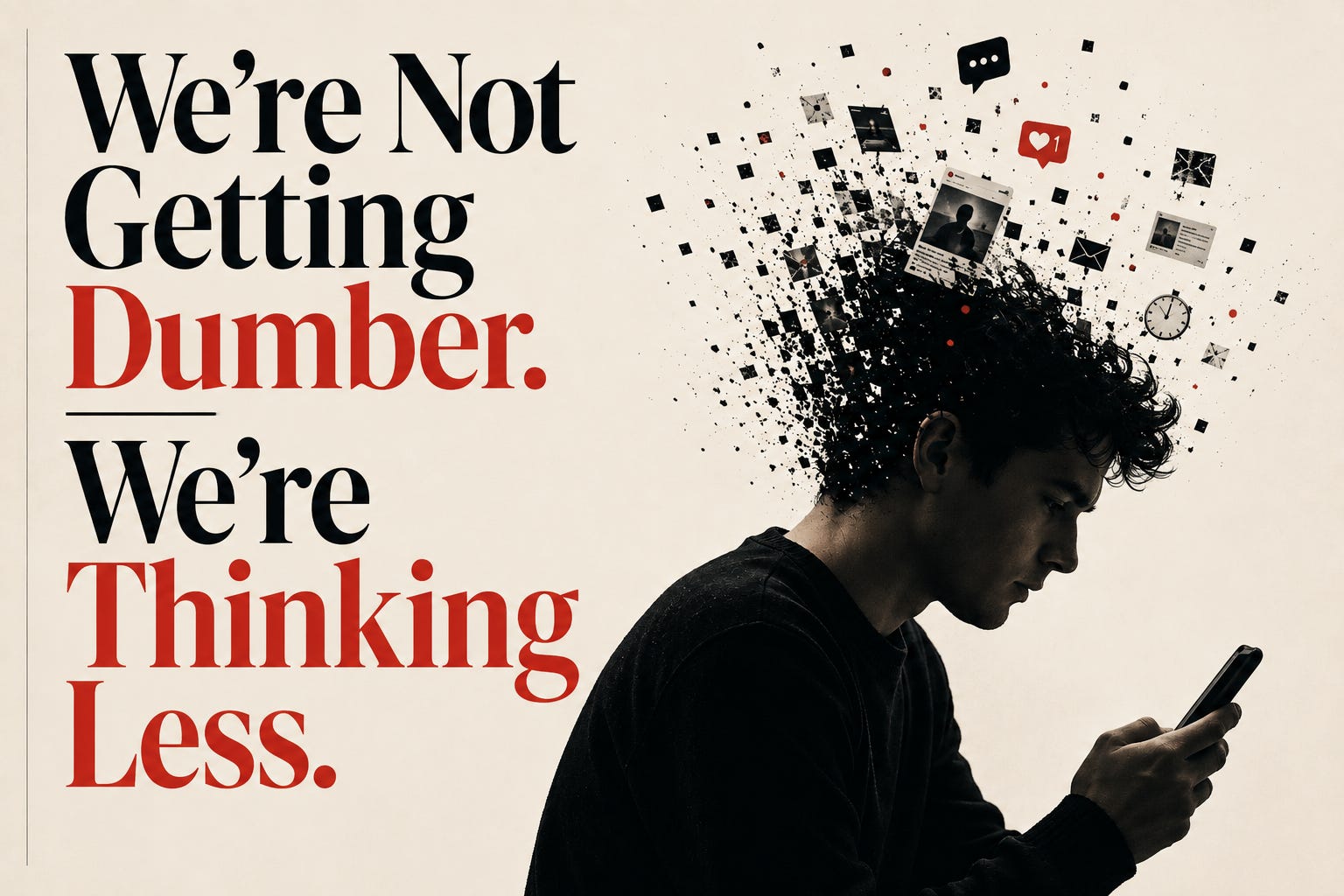
We’re not getting dumber. We’re thinking less. And the difference is not small.
It changes everything. Because intelligence is not simply the ability to store information. It is the ability to engage with it, to question it, to doubt it, to follow it to its limits.
And that ability is quietly fading. Not because people are incapable, but because the conditions for thinking are disappearing. For most of human history, thinking was slow. Knowledge was scarce. Books were rare. Ideas traveled slowly.
To understand something required effort.
To form an opinion required time. There was friction. And that friction forced depth. Today, friction is gone.
Information is immediate. Answers arrive before questions are fully formed.
Complex ideas are reduced to fragments, summaries, headlines. Everything is faster. And speed has a cost because thinking cannot be rushed. Real thinking unfolds. It moves step by step, often in silence, often in uncertainty. It requires attention that is sustained, not scattered.
But the modern environment is built against that. Attention is constantly interrupted.
Notifications, feeds, short bursts of content designed to capture and release focus in seconds. The mind adapts. It becomes quicker but shallower, more reactive but less reflective. This is not a moral failure. It is an environmental response.
Marshall McLuhan once argued that the medium is the message.
Not just what we consume, but how we consume. It reshapes the structure of the mind. A fast medium produces fast thinking. A fragmented medium produces fragmented attention.
And a constant stream produces a mind that rarely stops. But without stopping, there is no thinking, only movement.
The Disappearance of Deep Thinking
Philosophy understood this long before technology existed.
Socrates warned that an unexamined life is not worth living.
Not because life itself lacks value, but because without examination, it becomes automatic, driven by habit, by imitation, by unconscious patterns.
Thinking was meant to interrupt that, to slow it down, to question what appears obvious. But questioning requires discomfort. It introduces doubt. It removes certainty. It forces the mind to admit what it does not know. And today, not knowing has become unacceptable.
There is pressure to have an opinion immediately. To respond instantly, to take a position without reflection. Silence is interpreted as ignorance.
Hesitation is seen as weakness. So people speak before they think, react before they understand. And over time, the gap between information and understanding widens.
This is what creates the illusion of intelligence. The sense of knowing without the depth of comprehension.
Your support keeps the writing going — buy me a coffee to fuel the next piece.
The Culture of Speed and Superficiality
Friedrich Nietzsche described a similar phenomenon, not in terms of technology but in terms of culture. He warned of a future where comfort replaces struggle, where people avoid difficulty, avoid depth, avoid anything that demands effort. He called this figure the last man, not incapable, but unwilling, satisfied with ease, detached from meaning, uninterested in questioning.
What he described is not stupidity. It is the absence of engagement, the absence of the will to think deeply.
Because deep thinking is not pleasant.
It disrupts identity. It challenges beliefs. It exposes contradictions. And in a world that rewards certainty and speed, this becomes inconvenient. So the mind learns to skim, to recognize patterns without analyzing them, to agree or disagree without understanding, to move on before anything becomes uncomfortable. This creates a new kind of limitation. Not a lack of knowledge but a lack of depth. Not ignorance but superficial familiarity.
People know many things but understand few. They recognize ideas but cannot develop them. They repeat arguments but cannot examine them. This is where thinking begins to weaken. Quietly, gradually, almost invisibly. The danger is not obvious because functionality remains. People work. They communicate.
They navigate daily life. But the capacity for independent thought declines, and that has consequences because a mind that does not think deeply becomes dependent. Dependent on external interpretations, on simplified narratives, on ready-made conclusions.
It becomes easier to influence, not through force but through repetition, through exposure, through constant reinforcement of certain ideas.
Attention, Responsibility, and the Mind
This is why attention matters because attention is the foundation of thinking.
Hannah Arendt explored this in a different context. She observed that the absence of thinking does not create monsters. It creates ordinary people who fail to question, who follow systems, repeat ideas, and act without reflection. Not out of malice but out of thoughtlessness. Thinking, in her view, was not about intelligence. It was about responsibility.
The responsibility to examine, to pause, to resist automatic judgment. And that responsibility requires space. Space that is becoming increasingly rare.
Moments without input, moments without distraction, moments where the mind is not being filled. Because only in those moments can thinking begin. Not as reaction but as exploration.
This is why silence is uncomfortable. Because in silence, there is nothing to distract from. No new input, no new stimulation.
Only what is already there. Unresolved thoughts, unexamined beliefs, questions without answers. And most people avoid that encounter, not consciously but habitually. By filling every gap, every empty moment becomes an opportunity to consume. And as a result, the mind is never left alone with itself.
But thinking requires exactly that. To be alone with a question, to stay with it, to follow it without interruption, to resist the urge to replace it with something easier.
This is what builds depth. This is what builds clarity. And this is what is being lost. Not permanently, but progressively.
Thinking Can Be Recovered
The ability is still there. But like any ability, it weakens when unused and strengthens when practiced.
Because thinking is not automatic. It is an activity, a deliberate engagement with reality. It requires effort. It requires patience. It requires the willingness to not know.
But it also leads to something rare. Clarity.
Not borrowed clarity. Not secondhand understanding, but something direct, something earned. And once that clarity appears, it changes perception.
The world becomes less overwhelming. Ideas become easier to navigate.
Decisions become more grounded. Not because everything is known, but because thinking has returned.
This is the real distinction. Not between intelligence and stupidity, but between thinking and reacting, between depth and surface, between awareness and noise.
We are not getting dumber, but we are at risk of becoming less aware, less reflective, less capable of independent thought. And that is a different kind of loss, a quieter one, a more dangerous one because it does not announce itself. It blends in. It feels normal until one day thinking feels difficult. Silence feels uncomfortable and depth feels unnecessary.
At that point, the shift is complete. But it can be reversed.
Not through more information, but through less, less noise, less distraction, less constant input and more attention, more stillness, more time with a single thought followed fully without interruption, without urgency.
That is where thinking begins again. Not in complexity but in simplicity. A single question taken seriously, followed honestly.
And in that process, something returns. Clarity, and with it, freedom.
Because a mind that can think clearly cannot be easily shaped. It cannot be easily distracted. It cannot be easily convinced. It sees. And once something is truly seen, it cannot be unseen.
Help Sustain The Thinking Shelf
If this piece added something meaningful to your day, consider supporting the work. Even a small gesture — like buying me a coffee — helps keep this newsletter alive.
Ahhh the hazards of modern life...
Diving constantly and deeply into the shallow surface of things and ideas...
Silence is not golden...it is filled with stuff...that needs attenting to...
And that requires energy...a room...a chair and stillness...
Otherwise...attention all swimmers...please be advised...do not swim out of your depth...because...
Thank you
JAK
This is so true. We have more information than ever, but real thinking still requires us to slow down